PSA Grading Cost: The Full Price Breakdown
Everyone quotes the tier price; nobody quotes the invoice. PSA grading costs more than the number on the pricing page, because shipping, memberships, and declared-value bumps all ride along. Here’s the full breakdown as of mid-2026, the hidden line items, and a calculator for what your submission will actually cost, so the only surprises left are the grades.
Key Takeaways
- Value tiers run roughly $20-25 per card; speed multiplies the price fast.
- Each tier caps declared value: expensive cards must use expensive tiers.
- Budget shipping both ways, membership for bulk rates, and possible value bumps.
- A realistic 10-card value submission lands near $250-300 all-in, not $200.
- Rates change: psacard.com is the final word, and this page is your planning map.
Table of Contents
The Tier System Explained
PSA prices on two axes at once: speed and declared value. Each tier promises a faster turnaround than the one below it, and each caps the maximum value of the cards it accepts. Declare a card at $400 and the value tier (capped lower) is closed to you; the card must ride a pricier tier with a higher cap and better insurance.
The logic is fair enough: expensive cards demand more careful handling and more liability. The practical effect is that your card’s value sets your minimum price. A $2,000 vintage rookie can’t be graded for $25, full stop. That’s also why honest declared values matter: lowballing to sneak into a cheap tier gets caught at the value-bump stage anyway.
Current Tier Prices
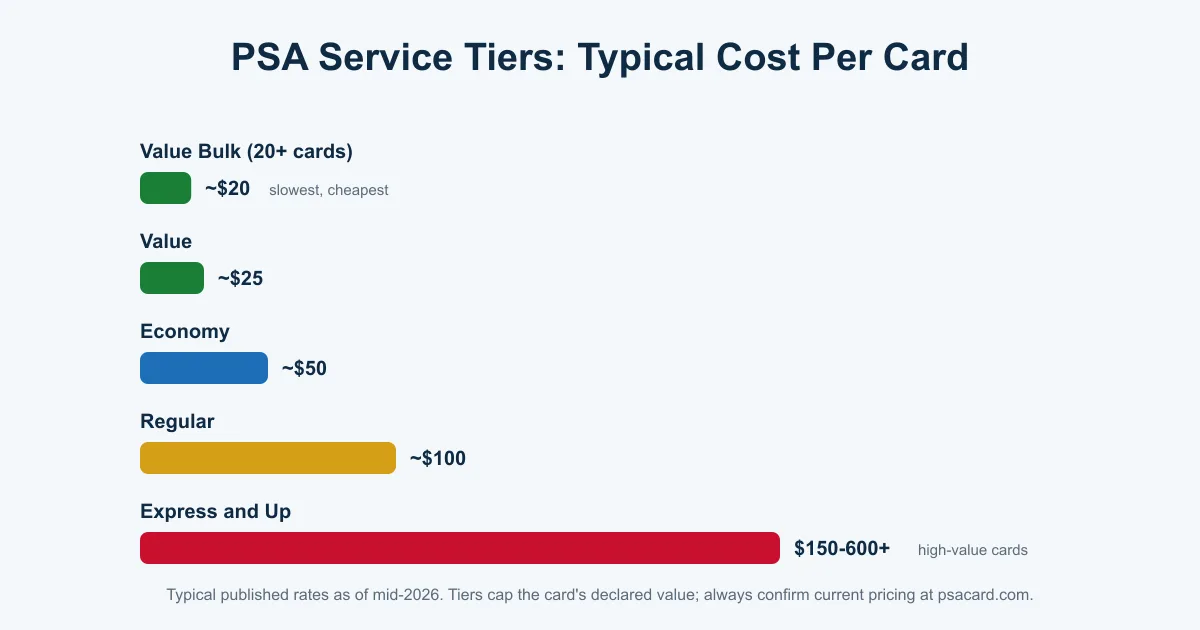
Planning numbers as of mid-2026 (always confirm at PSA’s pricing page, because these move):
| Tier | Typical Cost/Card | Value Cap | Realistic Wait |
|---|---|---|---|
| Value Bulk (20+ cards) | ~$20 | Low hundreds | Longest |
| Value | ~$25 | Low hundreds | Long |
| Economy | ~$50 | ~$1,000 | Moderate |
| Regular | ~$100 | ~$2,500 | Shorter |
| Express and up | $150-600+ | Five figures+ | Days to two weeks |
The wait column has its own full guide, because turnaround estimates deserve the same skepticism as tier prices.
The Hidden Costs
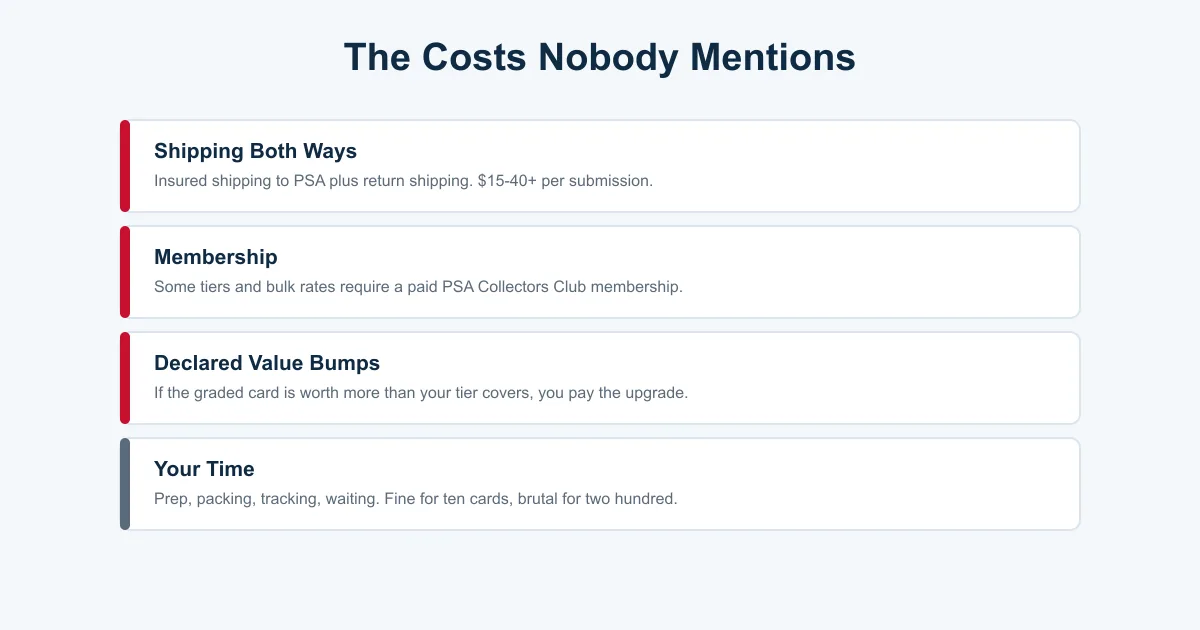
- Shipping both ways. Insured shipping to PSA plus return shipping billed on the order. Budget $15-40+ per submission depending on value and card count.
- Membership. Bulk rates typically require a paid PSA Collectors Club membership, which only pays for itself past a certain card count. Do that division before joining.
- Declared value bumps. Grade into money and you’ll pay for it: if your card comes back worth more than the tier cap (the good problem), PSA upgrades the order and bills the difference.
- Supplies. Penny sleeves, Card Saver I holders, and a sturdy box. Small money, but the right supplies are mandatory, not optional.
- Your time. Prep, forms, packing, tracking, unpacking. Free in dollars, real in life.
Submission Cost Calculator
True Submission Cost
Estimate the all-in cost of your PSA submission, per card and total.
That per-card number is the one to carry into the grading ROI calculator: fees spread across the submission, not the sticker price alone.
How to Pay Less
Legitimate ways to cut the invoice, in order of impact:
- Fill a bulk submission. The jump from $25 to $20 per card is 20 percent, and spreading fixed shipping across 20 cards instead of 5 saves more again. Patience assembles cheaper boxes.
- Split by value honestly. Send the $50 cards on value tier and the one $800 card on its proper tier separately. One expensive card must never set the tier for twenty cheap ones.
- Consider the GameStop option for modest modern cards: flat per-card pricing with no shipping logistics, at the cost of value caps and slower handling.
- Slow down. Express turns impatience into invoice. Unless the card is timing a market window, the slow tier and the fast tier return the same grade.
- Submit fewer, better cards. The cheapest grading fee is the one you skip on a card that was never going to clear the math. The grade-or-skip quiz is free.
Comparing the Competition on Price
PSA is rarely the cheapest option, which is worth knowing even if you land on PSA anyway. SGC’s pricing typically undercuts PSA’s value tier while grading faster, and Beckett’s rates run comparable to PSA with subgrades costing extra. The reason PSA still wins most profit submissions despite the premium is the resale gap: a PSA slab typically sells for enough more than the equivalent SGC slab to repay the fee difference and then some. The full three-way comparison walks through when that logic flips, and for keepers it flips often: protection is protection, and the cheapest respected slab protects just as well.
Is the Cost Worth It?
Cost is only half an answer; the other half is what the slab returns. For selling, that’s the expected-value math against real sold prices. For keeping, it’s protection and authentication priced at roughly a nice dinner per card. Both are fine answers. The only wrong answer is submitting first and doing the arithmetic after, which is the most popular order of operations in the hobby and the most expensive.
All prices are planning approximations as of July 2026. PSA’s published rates are the authority and change without notice. Not financial advice.
Frequently Asked Questions
How much does PSA grading cost per card?
As of mid-2026, value tiers run roughly $20 to $25 per card, economy around $50, and faster tiers from $100 into the hundreds. Each tier caps the card's declared value, and current prices live at psacard.com.
What is the cheapest way to grade cards with PSA?
Bulk value submissions, typically around $20 per card with a minimum card count and a PSA Collectors Club membership. GameStop's flat-rate in-store option can also beat mailing costs for modest cards.
Why did my PSA order cost more than the tier price?
Usually a declared value upgrade: if PSA judges your graded card to be worth more than your tier's maximum, the order is bumped to the appropriate tier and you pay the difference.
Is PSA grading worth the cost?
Only when the graded card's expected sale price beats the raw value plus every fee, or when you want protection and authentication for a keeper. Our grading ROI calculator does the math with your card's real numbers.