PSA vs BGS vs SGC: Which Grader Should You Use?
Three companies dominate card grading, all three are legitimate, and collectors still argue about them like division rivals. The real differences are narrower and more practical than the arguments suggest: what the market pays for each slab, what each label tells you, and what each submission costs. Here’s the honest comparison for hockey cards, from someone with all three slabs on the shelf.
Key Takeaways
- PSA slabs usually resell highest: the market premium, not accuracy, is its moat.
- BGS subgrades explain the grade, and the Black Label 10 is modern collecting's rarest flex.
- SGC delivers fast, affordable, respected grading, strongest on vintage.
- Grading to sell: PSA. Perfect modern keeper: BGS. Vintage on a budget: SGC.
Table of Contents
The Three Graders at a Glance
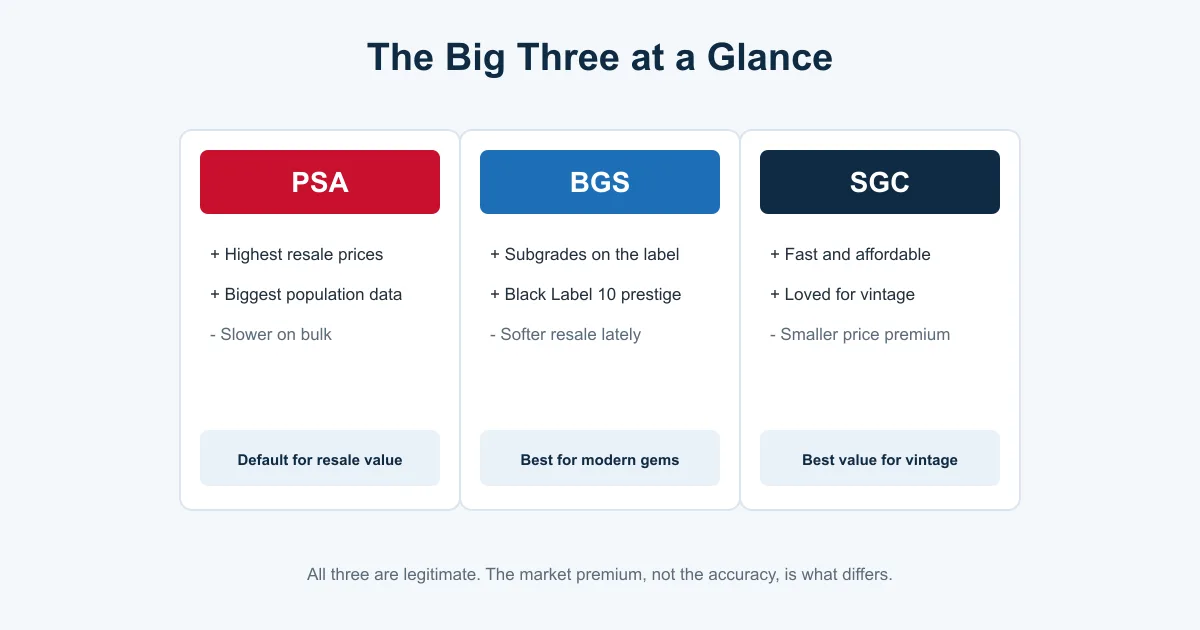
| PSA | BGS | SGC | |
|---|---|---|---|
| Resale premium | Highest | Middle | Lowest of the three |
| Signature feature | Population report depth | Four subgrades, Black Label | Speed and price |
| Strongest on | Everything liquid | Modern gems | Vintage |
| Typical cost | ~$20-25+ | Similar, subgrades extra | Often less |
| The slab | The default | Thick, subgrades on label | Black tuxedo, gorgeous with vintage |
PSA: The Market Standard
PSA grades more cards than anyone, and that scale is self-reinforcing: the deepest population data, the most recognizable slab, and the most liquid resale market. Identical cards routinely sell for more in PSA holders, which makes PSA the default answer whenever the exit plan involves selling.
The costs of being the standard: submission volume makes PSA’s slow tiers the slowest of the three when the hobby runs hot, and the price sheet is rarely the cheapest. You’re paying for the exit liquidity, and for cards headed to market, that’s usually the right thing to pay for.
BGS: The Subgrade Specialist
Beckett Grading answers a question the other slabs don’t: why did the card get its grade? Four subgrades (centering, corners, edges, surface) print right on the label, so a BGS 9.5 tells you whether centering or a corner held it back. For buyers, that’s real information; for gem chasers, it’s the whole sport.
Above it all sits the Black Label 10: perfect 10s across all four subgrades, rarer than a PSA 10 and priced accordingly on modern stars. The trade-off is the middle: ordinary BGS 9s and 9.5s typically resell below their PSA equivalents, so BGS makes the most sense when you’re either chasing the Black Label or keeping the card and valuing the subgrade detail.
SGC: The Value Play
SGC has graded since 1998 and earned its reputation the practical way: accurate grades, fast turnaround, lower prices, and the best-looking vintage presentation in the business. The black tuxedo slab against a 1971 O-Pee-Chee is genuinely the best display in grading.
The honest math: SGC slabs usually resell below PSA equivalents, so for pure investment flips, the discount going in gets returned going out. Where SGC shines is everything else: protecting a collection affordably, grading vintage where the community respect runs deepest, and getting slabs back while PSA’s value tier is still in month two. My vintage keepers are SGC and I’ve never regretted one.
Which Grader for Which Card
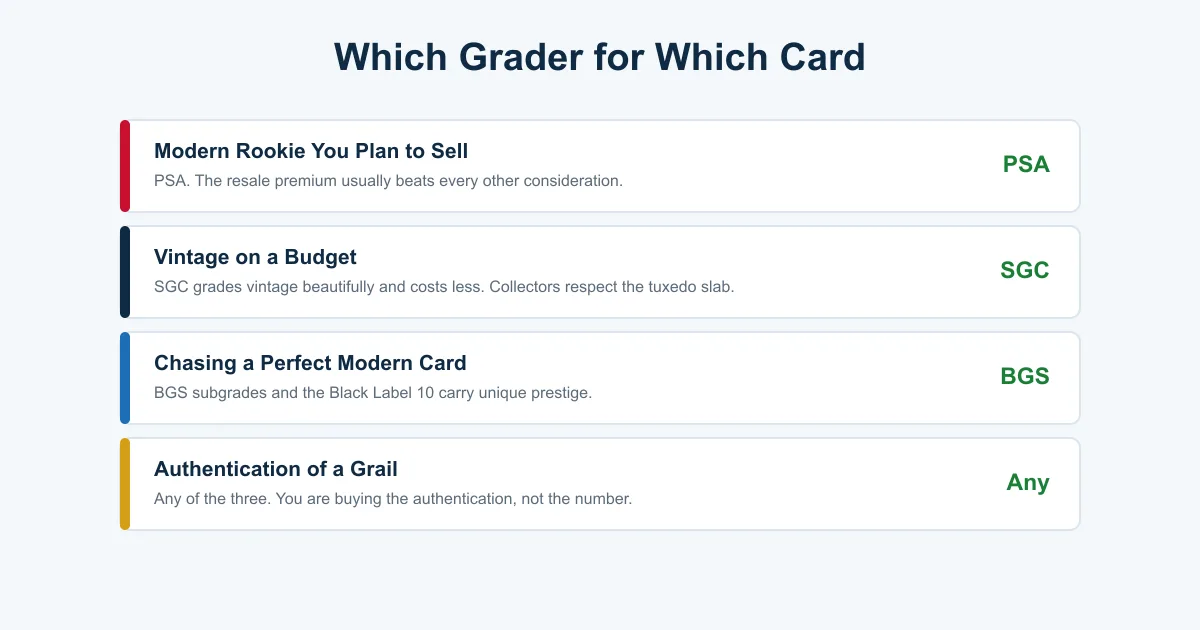
The four common cases:
- Modern rookie you plan to sell → PSA. The resale premium usually beats every other consideration, full stop.
- Vintage on a budget or for display → SGC. Cheaper in, gorgeous on the shelf, fully respected by vintage buyers.
- Perfect modern card you’re keeping → BGS. Subgrades document the perfection, and the Black Label lottery exists nowhere else.
- Grail needing authentication → any of the three. Authentication quality is comparable; pick on cost and turnaround, then verify the cert like any buyer would.
Grader Picker
Which Grader Fits Your Card?
Three questions, one recommendation.
Crossovers and Regrades
The graders will grade each other’s slabs. Crossover services examine a card in its existing holder and re-slab it only if it meets your minimum grade, which protects you from a downgrade. The classic move is crossing BGS or SGC cards to PSA to capture the resale premium; the classic mistake is assuming a 9.5 crosses to a 10. Set the minimum at the equivalent grade and treat anything better as a bonus.
Two practical crossover notes from experience: budget the same fee as a fresh submission plus the risk that the card fails your minimum and comes back untouched (you pay either way), and check the sold-price gap between the slabs before assuming a cross profits. On a card whose PSA premium is $15, crossing is a hobby, not a strategy.
The meta-lesson of the whole debate: the grade matters more than the label, and the card matters more than the grade. Get the right cards graded for the right reasons, and any of the big three will treat you fine. Get those wrong, and no slab fixes it.
Market premiums and services shift over time. Check each company’s current pricing and offerings before submitting. Not financial advice.
Frequently Asked Questions
Is PSA better than BGS?
For resale value, usually yes: identical cards typically sell higher in PSA slabs. BGS counters with subgrades and the Black Label 10, which collectors prize on perfect modern cards. Grading accuracy is comparable; the market premium is the real difference.
What is a BGS Black Label?
A BGS 10 with perfect 10 subgrades in all four categories: centering, corners, edges, and surface. It is rarer than a PSA 10 and commands spectacular premiums on the right modern cards.
Is SGC grading respected?
Yes, especially on vintage. SGC has graded since 1998, its tuxedo slabs display vintage beautifully, and its lower prices and fast turnaround have won over many collectors. SGC slabs usually resell below PSA equivalents, which is the trade.
Can I crossover a card from one grader to another?
Yes. Crossover services grade the card in its existing slab and re-holder it if it meets your minimum grade. Collectors typically cross BGS and SGC cards to PSA chasing the resale premium.