Hockey Rookie Cards: The Complete Collector's Guide
Rookie cards are the beating heart of the hobby. They are the cards that set auction records, the cards new collectors chase first, and the cards that turn a hot prospect into a $37,000 piece of cardboard. This is the complete guide to hockey rookie cards: what actually counts as one, why Young Guns rule the modern market, and how to value, identify, and time them without getting burned by the hype.
I have chased rookies for over a decade, from vintage O-Pee-Chee to this year’s fresh Young Guns, and the single most valuable thing I have learned is that a rookie card is a bet on both a player and a market that behaves very predictably. Understand both and you will collect smarter than most of the hobby.
Key Takeaways
- A rookie card is a player's first card in a major NHL-licensed set, marked with an RC logo.
- Upper Deck Young Guns is the modern flagship rookie, and the headline rookie lands at #451.
- Rookie prices spike at debut and almost always settle lower: Bedard's PSA 10 fell from ~$2,500 to ~$550.
- Value stacks on player, scarcity, and grade, exactly like the rest of the hobby.
- The current class to know: Bedard (2023-24), Celebrini (2024-25), and Schaefer (2025-26).
Table of Contents
What Actually Counts as a Rookie Card
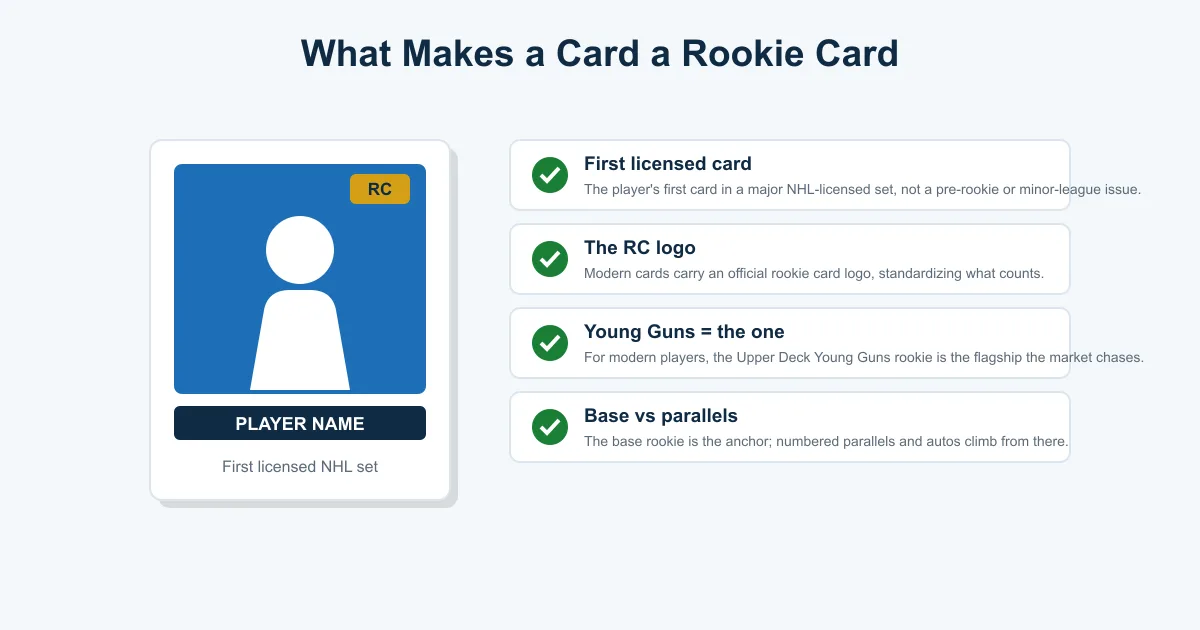
A rookie card, in the strict modern sense, is a player’s first card in a nationally distributed, NHL-licensed set, released during or just after their first professional season. Three things separate a true rookie card from the pretenders:
- It carries the RC logo. Since the early 2010s, manufacturers stamp an official rookie card logo on cards that qualify, which cleaned up decades of arguments about what counts.
- It is not a pre-rookie card. Draft-pick cards, prospect cards, and junior-league issues that predate a player’s NHL debut are collectible, but they are not the rookie card. Collectors and price guides treat them as a separate, usually lesser, category.
- It is the base of a pyramid. The base rookie is the anchor. Above it sit numbered parallels, patches, and autographs that climb in scarcity and price, a structure I break down in the values guide.
One clarification that trips people up: a player can have many rookie cards across different products in the same season, but the hobby crowns one as the rookie card. In modern hockey, that crown almost always goes to the Young Guns.
Young Guns: The Modern Flagship
If you learn one thing about modern hockey rookies, learn Young Guns. Upper Deck launched the Young Guns subset in 1990-91, and for over three decades it has been the definitive rookie card line in the sport. When a collector says “I pulled his rookie,” they almost always mean the Young Guns.
Why does one subset dominate so completely?
- Short-printed within a mass product. Young Guns are seeded at tougher odds than base cards inside Upper Deck’s flagship release, so they carry real relative scarcity while staying attainable enough to build a liquid market.
- Consistency. The same recognizable design language, year after year, means the whole hobby speaks one language about rookies. That shared understanding is worth money.
- Liquidity. Young Guns are the most graded, most listed, and most searched hockey rookies on eBay and every price tracker. Liquidity compounds: the easier a card is to buy and sell, the more people want it.
Here is the insider detail that will make you look sharp at a card show: the headline rookie each season lands at card #451, the Young Guns slot in Series 2. Bedard is 2023-24 #451. Celebrini is 2024-25 #451. Schaefer is 2025-26 #451. Memorize that number and you can find any recent flagship rookie in seconds.
The Vintage Rookie Legends
Before Young Guns, rookie value was an accident of survival. The great vintage rookies became grails because almost nobody protected cards in 1951 or 1966 or 1979, so high-grade copies are freaks of history. These are the cards that anchor the most valuable hockey cards list:
- 1979 O-Pee-Chee Wayne Gretzky. The most valuable hockey card ever, $3.75 million as a PSA 10. The rookie card by which all others are measured.
- 1966 Topps Bobby Orr. The defenseman who redefined the position, and a six-figure rookie in top grade.
- 1951 Parkhurst Gordie Howe. Mr. Hockey’s rookie from the set that launched the modern hockey card.
- 1985 O-Pee-Chee Mario Lemieux. Where 1980s print quality makes a true gem genuinely rare.
- 2005-06 Upper Deck Sidney Crosby Young Guns. The card that turned the modern Young Guns era into a phenomenon, and proof that the subset produces grails too.
Vintage rookies reward a different skill than modern ones. Condition and authentication dominate, O-Pee-Chee versions usually outvalue their Topps twins, and grading is almost always worth it on a real star. The market is also far more stable than the modern rookie roller coaster, which brings us to the single most important concept in this entire guide.
The Rookie Hype Curve
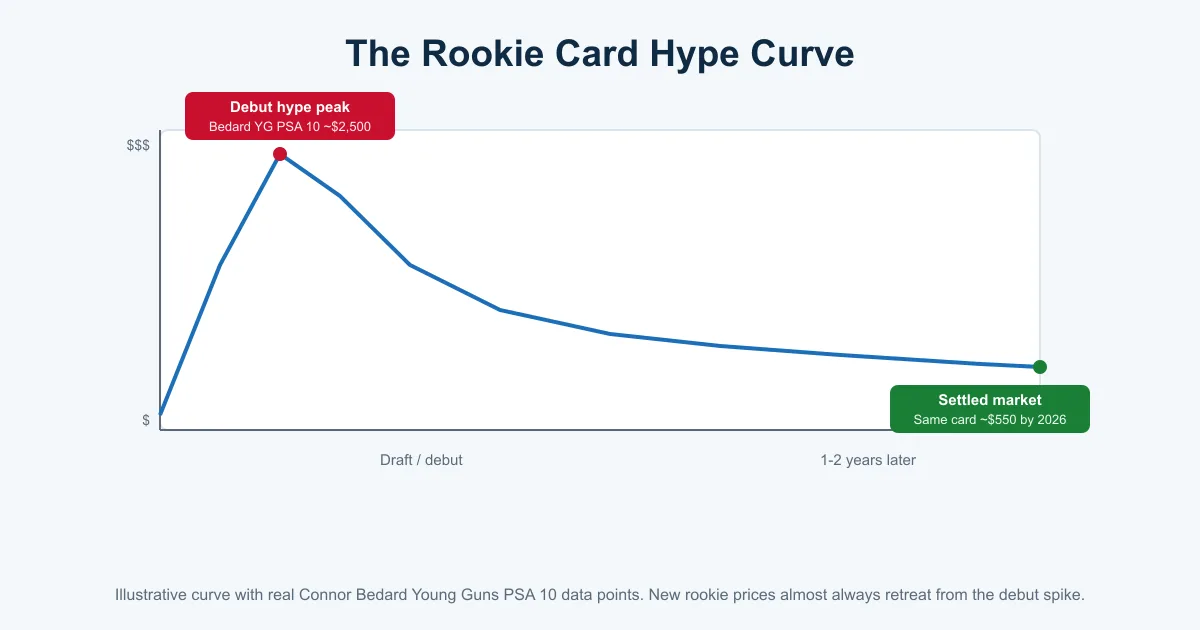
Modern rookie cards follow a pattern so reliable you can set your watch by it. Prices spike hard around the debut, when hype is maximum and graded supply is minimum, then settle as more copies hit the market and reality replaces imagination.
Connor Bedard is the textbook case. His 2023-24 Young Guns PSA 10 reached roughly $2,500 in the frenzy of early 2024, with outlier sales reported even higher. By mid-2026 the same card was averaging in the $550 to $685 range across more than 100 sales, according to Card Ladder data. Nothing went wrong with Bedard. The card simply did what rookie cards do: the debut premium decayed as supply caught up with demand. Puck Junk documented this decline in detail while it was happening.
The lessons that fall out of the curve:
- Do not buy at the peak. The worst time to buy a rookie is the moment everyone is talking about it. Patience is a discount.
- Supply is the enemy of the premium. Every graded copy that enters the market pushes the price down. Early scarcity is temporary by design.
- The floor tells you the truth. A rookie’s settled price a year or two out reflects real collector demand, stripped of hype. That is the number worth paying.
- Timing beats selection for returns. Buying the right rookie at the wrong time loses money; buying a good rookie at the settled price wins.
This is also why grading a rookie during the hype is a trap: your slab often returns to a cooler market months later, a dynamic I cover in the turnaround guide.
The Current Class: Bedard, Celebrini, Schaefer
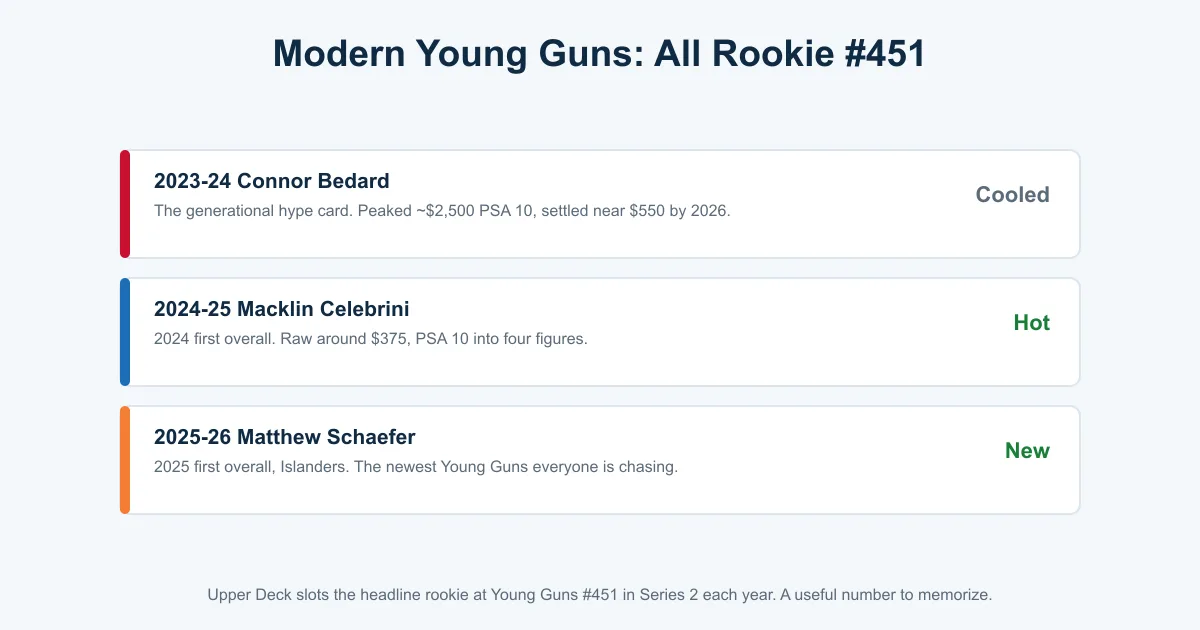
Three first-overall picks define the current rookie landscape, and conveniently they form a clean three-year lineage at Young Guns #451:
- Connor Bedard (2023-24). The generational hype card, now a case study in the hype curve above. His settled market makes his Young Guns one of the more attainable elite modern rookies today, which is exactly what the curve predicts. Full breakdown in the Connor Bedard rookie card guide.
- Macklin Celebrini (2024-25). The 2024 first overall pick to the San Jose Sharks. His base Young Guns trades around $375 raw with PSA 10 copies into four figures, and his Cup Rookie Patch Auto has reportedly sold north of $30,000. Full breakdown in the Macklin Celebrini rookie card guide.
- Matthew Schaefer (2025-26). The 2025 first overall pick, a defenseman drafted by the New York Islanders, and the newest rookie the hobby is chasing. Blueliners rarely go first overall, which makes his story unusual, and his Young Guns is the freshest #451 on the market. Full breakdown in the Matthew Schaefer rookie card guide.
Watching these three move through the hype curve in real time is the best hobby education available. Bedard shows you the settled floor, Celebrini shows you the mid-cycle market, and Schaefer shows you the debut spike as it happens.
How to Value and Identify a Rookie Card
The process is the same discipline that runs through the whole site, tuned for rookies:
- Confirm it is the rookie. Check for the RC logo and verify the set on the Trading Card Database. For modern players, make sure you are looking at the Young Guns, not a base card or a pre-rookie prospect issue.
- Identify the exact version. Base, parallel, numbered, auto. A Celebrini base Young Guns and a Celebrini Cup RPA /99 are different markets by a factor of a hundred.
- Pull recent sold prices. Use the eBay sold-listings method and cross-check the trend on Card Ladder, since rookie prices move fast enough that last month’s number can mislead.
- Judge condition honestly. The PSA 10 premium is enormous on modern rookies, so a gem versus a nine is often a doubling or more. Assess like a grader before you dream.
- Locate the card on the hype curve. Debut spike, mid-cycle, or settled floor. This single judgment matters more than any other for what you should pay.
Should You Buy This Rookie Now?
Rookie Buy-Timing Estimator
Answer three questions for a read on whether to buy, wait, or hold.
Whatever the tool says, the rookie card game rewards the same temperament as the rest of collecting: know the player, know the card, know the number, and let patience do the heavy lifting. Buy the cards you love at prices the market confirms, treat every hot rookie as a hype curve waiting to happen, and you will build a rookie collection you are proud of instead of one you are underwater on.
Ready to go deeper on the current class? Start with the Macklin Celebrini rookie card guide and the Matthew Schaefer rookie card guide, then decide where each sits on the curve.
Card values are reported ranges from public marketplace data as of July 2026 and move constantly. Nothing here is financial advice. Collect what you love.
Frequently Asked Questions
What is a rookie card in hockey?
A rookie card is a player's first card in a major NHL-licensed set, released during or just after their first pro season. Modern rookie cards carry an official RC logo, and for most current players the Upper Deck Young Guns card is the flagship rookie the market chases.
What are Young Guns cards?
Young Guns is Upper Deck's rookie subset, short-printed within its flagship hockey release since 1990-91. Young Guns are the most recognizable, most graded, and most liquid modern hockey rookie cards, and the headline rookie each year lands at card #451 in Series 2.
Are hockey rookie cards a good investment?
Treat them as a hobby first. Rookie cards of generational players can hold real value, but prices are volatile and almost always spike at debut before settling. Connor Bedard's Young Guns PSA 10 fell from roughly $2,500 to around $550 within two years.
How do I know if a card is a rookie card?
Look for the RC logo, confirm it is the player's first licensed NHL card (not a pre-rookie prospect card), and check the set and card number on the Trading Card Database. For modern players, the Young Guns is the rookie that matters most.
Which current hockey rookies are worth collecting?
As of 2026, the headline rookies are Connor Bedard (2023-24), Macklin Celebrini (2024-25), and Matthew Schaefer (2025-26), each the first overall pick in their draft and each with a Young Guns #451 rookie card.