How to Get Cards Graded: The Full PSA Walkthrough
The first grading submission feels like a final exam: forms, declared values, special holders, and the low hum of fear that you’ll pack something wrong and hurt your own cards. Relax. I’ve sent plenty of boxes to the graders, and the process is a checklist, not a test. Here’s the complete walkthrough, from shortlist to the day the slabs come home.
Key Takeaways
- Shortlist with math first: only submit cards where the expected grade clears fees.
- Penny sleeve + Card Saver I is the required outfit. No toploaders for PSA.
- Cards must match your submission form order exactly.
- Pack snug, ship insured with tracking, and keep every receipt.
- Handle cards like evidence: edges only, clean hands, no cleaning experiments.
Table of Contents
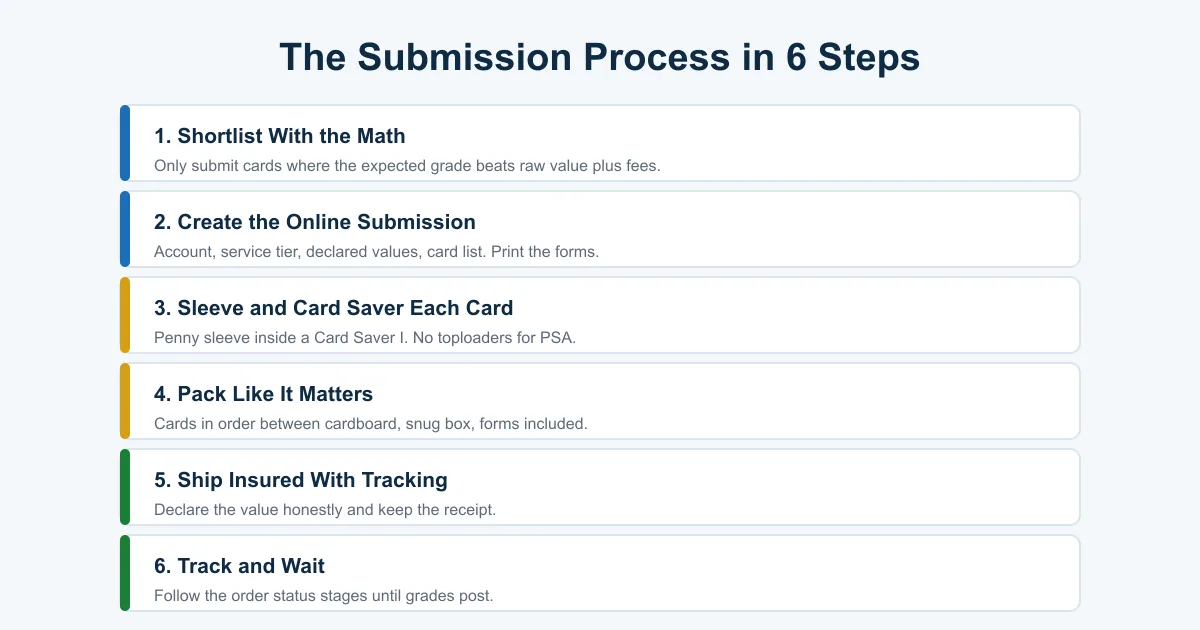
Step 0: Shortlist With the Math
The best packing job in the world can’t save a submission that never should have shipped. Before anything touches a sleeve: pull sold prices for each card at its realistic grades, run the ROI math, and cut every card that only profits at a perfect 10 you can’t honestly promise. The grade-or-skip quiz is the fast version; the condition checklist is the honest one.
Keepers you’re grading for protection skip the math and ride along at the cheapest tier. That’s allowed and encouraged; just know which cards are which before the invoice arrives.
Step 1: Create the Submission
At PSA’s submission center, the online flow walks you through it:
- Account (free) and a new submission.
- Add each card: sport, year, set, card number, player. Accuracy matters, since this list becomes the processing manifest.
- Declared value per card: your honest estimate of the card’s value after grading. This sets insurance and eligible tiers, and lowballing gets corrected at your expense later, so just be honest.
- Pick the service tier. Speed costs; the cost breakdown covers the tiers, and slow is correct for almost everything.
- Print the forms. They ship inside the box with the cards.
Step 2: Prep Each Card
The required outfit, inside out:
- Penny sleeve first. Soft sleeve, card slid in gently, no snags on the corners you’re paying to protect.
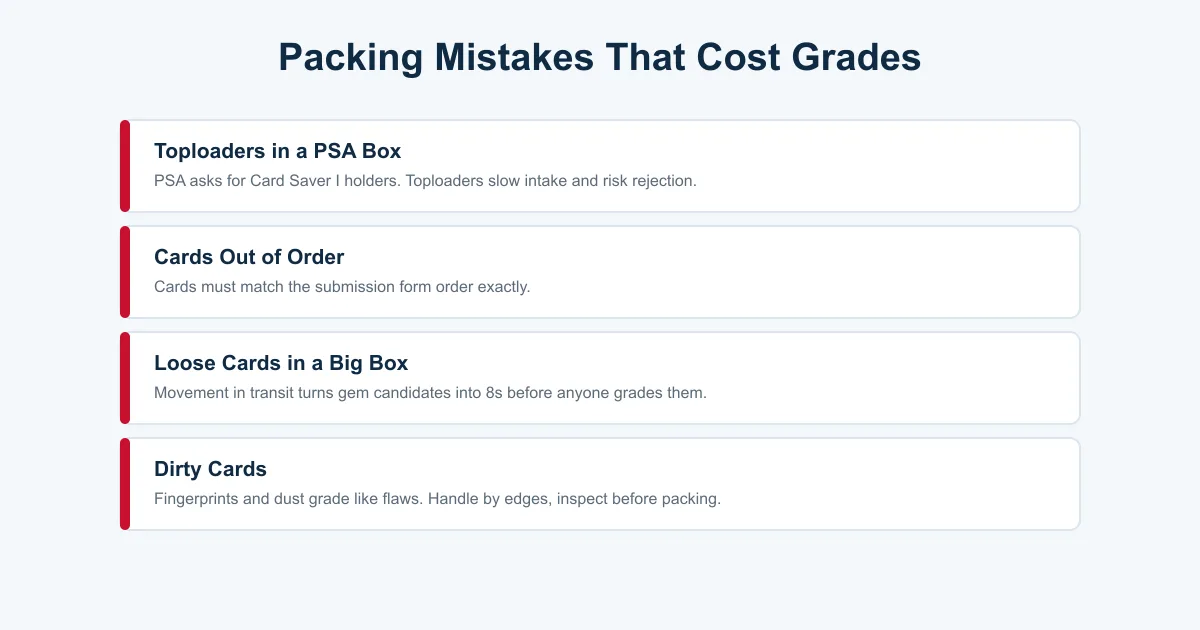
- Card Saver I second. The semi-rigid holder PSA asks for. Not a toploader: PSA’s own packaging guidance is explicit, and toploaders genuinely slow intake.
- Handle like evidence. Edges only, clean dry hands. Fingerprints on modern gloss read as surface flaws.
- Do not clean beyond a gentle microfiber wipe. No liquids, no erasers, no miracle products from the internet. Alteration attempts can tank a grade or void grading entirely, and graders have seen every trick.
Step 3: Pack the Box
The packing rules that matter:
- Order is law. Cards must sit in the exact order of the submission form. Mismatches slow processing and invite errors on your account.
- Sandwich and snug. The stack of Card Savers goes between cardboard pieces, rubber-band-free, in a box where nothing shifts when shaken gently. Movement in transit is how gem candidates arrive as 8s.
- Forms in the box. The printed submission forms ride with the cards.
- No extras. No loose cards, no notes asking for good luck, no surprises. Boxes that match their manifest move fastest.
Step 4: Ship It Right
Insured, tracked, and honestly declared. Use a carrier you trust with the declared value of the whole box, require signature on delivery for anything substantial, and photograph the packed box before sealing (cheap insurance for any dispute). Keep the receipt and tracking number until the slabs are home. This is the same discipline as shipping a sold card, scaled up to a box that might hold your best cardboard.
Step 5: Track and Receive
Your PSA account shows the order moving through stages (arrived, order prep, research and ID, grading, assembly, shipped), and the turnaround guide decodes what each stage means and how long the whole ride honestly takes. Grades usually appear in your account before the box ships back, which produces the hobby’s finest five minutes of refreshing a webpage.
When the slabs arrive: inspect each against the order, verify a cert or two for the satisfaction of it, and update your records with the grades. Compare your predictions to the results too. Tracking that gap is how your eye improves, and PSA’s published grading standards explain most of the surprises: the 9 you expected to gem almost always has a surface or centering call you can now find. Then comes the fork: keepers to the shelf, sellers to market with their shiny new comps, priced against fresh sold listings for the grades you actually got.
Submission Prep Checklist
Pre-Ship Checklist
Run it before taping the box. All green means ship.
First submission done, the fear evaporates: it’s sleeves, order, cardboard, insurance. The only step that ever stays hard is the honest shortlist, and that’s exactly the step that decides whether the box that comes back feels like a win.
Submission requirements and packaging guidance belong to the grading companies and change occasionally. Check PSA’s current instructions before shipping. Not financial advice.
Frequently Asked Questions
How do I submit cards to PSA?
Create a free account at psacard.com, build an online submission with your cards and declared values, choose a service tier, print the forms, pack each card in a penny sleeve inside a Card Saver I, and ship insured with the paperwork.
Do I need toploaders to submit to PSA?
No, and PSA specifically asks you not to use them. Cards should go in penny sleeves inside semi-rigid holders like Card Saver I. Toploaders slow intake and can lead to processing problems.
How should I clean a card before grading?
Barely. Handle by the edges, use a soft microfiber wipe for fingerprints on modern gloss, and never use liquids or erasers. Cleaning attempts cause more grade damage than dust ever does, and alterations can void grading.
Can I submit cards to PSA without a membership?
Yes for standard tiers. Membership mainly unlocks bulk pricing, so do the math: it pays for itself only past a certain card count per year.