Hockey Card Values: How to Find Out What Your Cards Are Worth
Whether you found a shoebox of cards in your parents’ basement or you rip wax every weekend, the first question is always the same: what are these hockey cards actually worth?
Here’s the honest answer. Most hockey cards are worth almost nothing, and a small number are worth more than you’d guess. This guide shows you how to tell the difference in about ten minutes, using free tools and real sold prices. It’s the exact process I use before I buy, sell, or submit anything for grading.
Key Takeaways
- Real value comes from eBay sold listings, never asking prices.
- Player, rookie status, scarcity, condition, and grading drive almost all value.
- Most 1988-1994 cards are worthless due to massive print runs.
- Grade a card only when the math works: run it through the calculator below.
- Cross-check at least two price sources before trusting any number.
Table of Contents
- The Golden Rule: Sold Prices, Not Asking Prices
- How to Check Sold Prices on eBay, Step by Step
- Free Price Guide Tools Worth Using
- What Actually Makes a Hockey Card Valuable
- The Most Valuable Hockey Cards Ever Sold
- Are Your 90s Cards Worth Anything?
- How to Check Condition Like a Grader
- Is Grading Worth It? Run the Numbers
- Where to Sell Hockey Cards
- What to Do Next
- Frequently Asked Questions
The Golden Rule: Sold Prices, Not Asking Prices
The biggest mistake people make when valuing hockey cards is looking at what sellers ask. Anyone can list a card for $500. What matters is what buyers actually pay.
Asking prices run high for a simple reason: optimistic sellers never get punished for overpricing. A card listed at triple its value just sits there, and it sits there looking like “the market price” to anyone who doesn’t know better. Meanwhile the same card quietly sells five times a month at a fraction of that number.
Price guide books have the opposite problem. Printed guides lag the market by months, and the hobby moves fast. A hot playoff run, a trade, or an injury can move a player’s card prices 50 percent in weeks. Sold listings are the market, updated in real time.
So the golden rule: every value question starts and ends with recent sold prices. Here’s exactly how to pull them.
How to Check Sold Prices on eBay, Step by Step
eBay is the biggest card marketplace on earth, which makes its sold-listing history the closest thing the hobby has to a live price feed. The whole process takes two minutes:
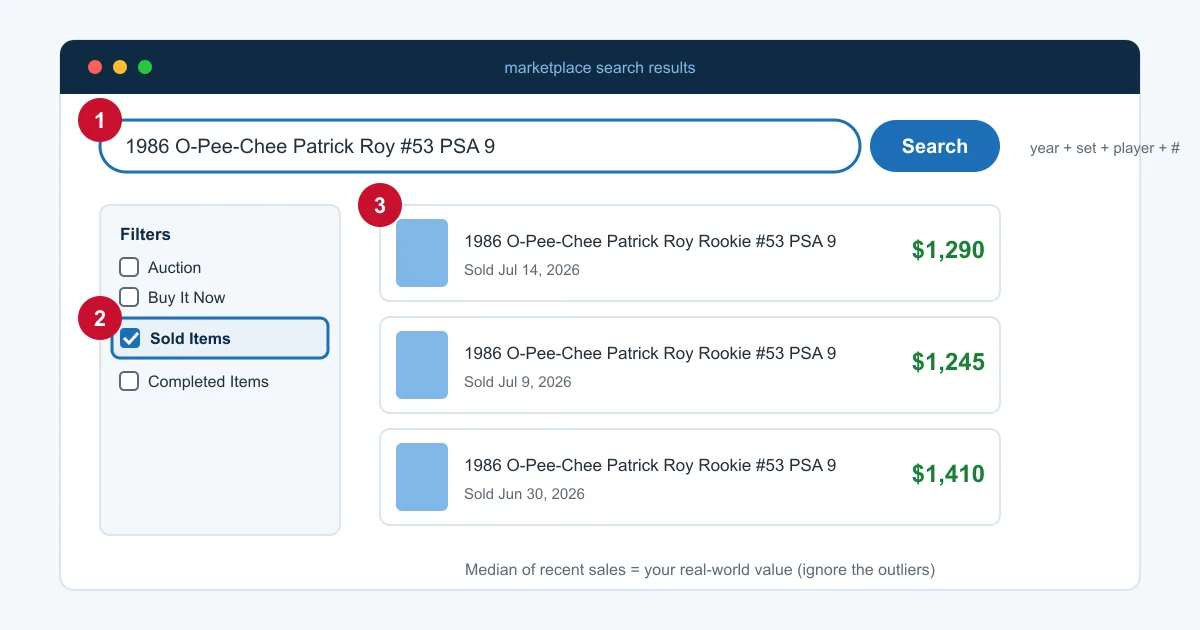
- Search the exact card. Use year + set + player + card number, like “1986 O-Pee-Chee Patrick Roy #53”. The card number is printed on the back. Skipping it mixes in different cards of the same player and muddies your results.
- Filter by Sold Items. On desktop it’s a checkbox in the left sidebar. On mobile, open Filters and toggle “Sold Items”. The listings turn into completed sales with green prices and sale dates.
- Read the last 5 to 10 sales. One outlier means nothing. A single $1,400 sale between a pile of $1,250 sales is a bidding war, not the market. Take the middle of the recent range as your real-world value.
A few pro tips that sharpen the results:
- Match condition to condition. A raw card and a PSA 9 of the same card are different markets. Add “PSA 9” or “raw” to the search when checking a specific version.
- Watch the sale dates. Five sales from the last month beat twenty sales from last year. If the recent trend is falling, the older prices flatter your card.
- Be suspicious of weird outliers. Occasional sales close way above or below the pack because of shill bidding, typos, or bundled extras. Ignore them.
- Save the search. eBay lets you save any search and get alerts, which is the easiest way to track a card you’re thinking about selling.
To skip the setup, the card value finder builds the exact eBay sold-listings search from your card details in one click.
Free Price Guide Tools Worth Using
Sold listings are the source of truth, but a few free tools organize that data and save you time:
- SportsCardsPro: a free price guide that splits values by condition and grade. Search the card, and you get columns for ungraded through PSA 10 side by side. Great for a fast “is this worth anything” triage of a big pile.
- PSA Price Guide: values for graded cards straight from the biggest grading company. Most useful for seeing the gap between grades, which is exactly the number you need for grading decisions.
- Card Ladder: the hobby’s price-history tool. It charts a card’s sales over time like a stock, so you can see whether a player’s market is climbing, cooling, or spiking on news. The free tier covers a lot; the paid tier adds portfolio tracking.
My workflow: triage the pile with SportsCardsPro, confirm anything interesting against eBay sold listings, and check Card Ladder’s chart before actually selling so I’m not dumping a card into a rising market.
Cross-check at least two sources before believing any number. When a guide and recent sold listings disagree, the sold listings win. Every time.
What Actually Makes a Hockey Card Valuable
Five factors drive nearly all hockey card value:
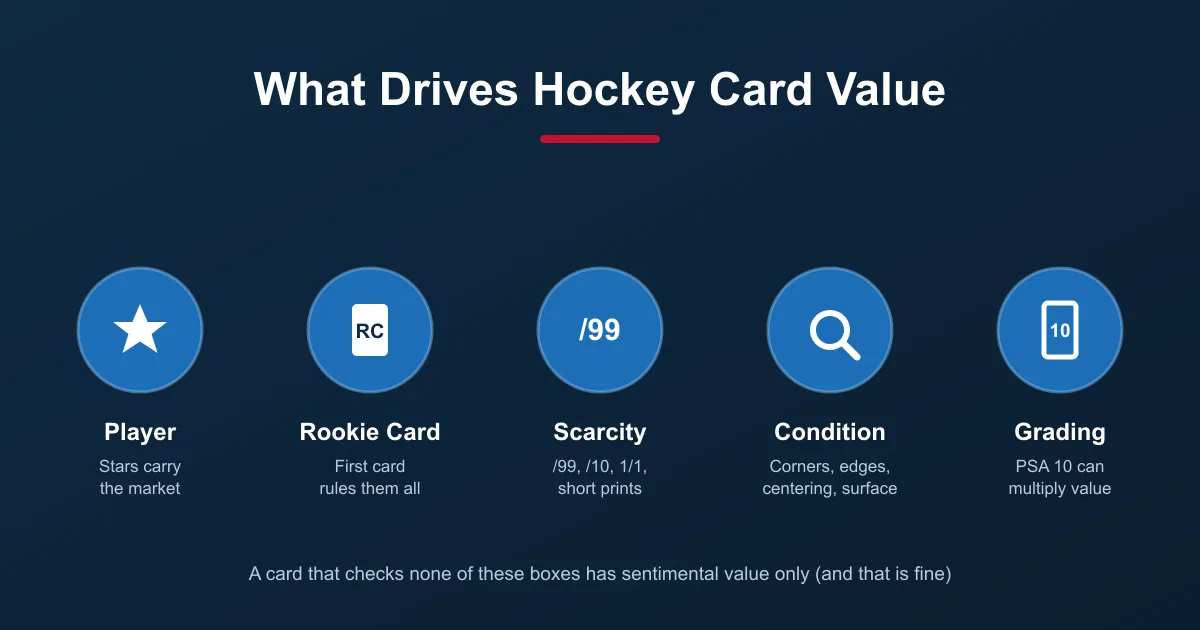
| Factor | Why It Matters |
|---|---|
| Player | Superstars and elite rookies carry the market. A common card of a legend beats a rare card of a fourth-liner. |
| Rookie Card | A player’s first licensed card is almost always their most valuable. In modern hockey that usually means Upper Deck Young Guns. |
| Scarcity | Serial-numbered cards (/99, /10, 1/1), short prints, and low-print vintage beat mass-produced cards. |
| Condition | Centering, corners, edges, surface. The gap between near mint and played-with can be 10x. |
| Grading | A PSA 10 often sells for several times what a raw copy brings. |
The factors multiply each other, which is the part most people miss. A star player alone is worth a little. A star player’s rookie card is worth more. A serial-numbered star rookie in gem-mint condition, graded, is worth a lot. That multiplication is why two cards from the same set can differ in price by a thousand times.
If a card checks none of these boxes, like a 1991 common of a role player, it has sentimental value only. And that’s fine. That describes most of every collection, including mine.
The Most Valuable Hockey Cards Ever Sold
Want to see the ceiling? These are the sales that made headlines, and each one shows the value factors stacking together:
| Card | Reported Sale | Why It’s Worth That |
|---|---|---|
| 1979 O-Pee-Chee Wayne Gretzky rookie, PSA 10 | $3.75 million (2021) | The greatest player ever, his rookie card, and one of only two PSA 10 copies known. |
| 2005-06 Upper Deck The Cup Sidney Crosby rookie patch auto /99 | Reported at over $3 million (2022) | Rookie card, autograph, game-worn patch, and serial-numbered to 99. Every factor at once. |
| 1966 Topps Bobby Orr rookie, high grade | Six figures | Vintage scarcity plus the most important defenseman in history. |
| 1951 Parkhurst Gordie Howe rookie, high grade | Strong five to six figures | Mr. Hockey’s rookie from the set that launched the modern hockey card. |
| 1985 O-Pee-Chee Mario Lemieux rookie, PSA 10 | Six figures | Superstar rookie where gem-mint copies are genuinely rare due to 80s print quality. |
Prices move, and record sales are outliers by definition. But the pattern is the lesson: legend, rookie card, scarcity, and top grade, all at once. When you evaluate your own cards, count how many of those boxes each one checks. The full top 25 list breaks down every record card and what it teaches.
For modern reference points: recent Young Guns rookies of generational players like Connor Bedard or Connor McDavid sell for hundreds raw and can reach four figures as PSA 10s, while Young Guns of ordinary NHL regulars sell for a few dollars. Same set, same year, wildly different value. The player is doing all the work.
Are Your 90s Cards Worth Anything?
Probably not, and the reason matters. From roughly 1988 to 1994, the junk wax era, card companies printed astronomical quantities. Millions of every card. Pro Set, Score, 1990-91 Topps and Bowman, and most O-Pee-Chee of that window fall into this bucket. Supply swamps demand forever, so even the stars from those sets sell for pocket change.
The exceptions worth checking:
- 1990-91 Upper Deck: a landmark set that raised the bar for card quality. Key rookies in graded gem-mint condition hold real value even though raw copies don’t.
- Pre-1980 vintage: anything older than the junk wax boom deserves a real lookup, especially O-Pee-Chee and Parkhurst.
- Graded high-grade copies: even junk-era cards can be worth money as a PSA 10, because so few survived in perfect condition. The card is common; the grade is rare.
- Tim Hortons and food-issue oddballs: regional promo sets and hologram inserts have cult followings, and some sell better than you’d expect.
The quick test for a 90s pile: pull out only the biggest names (Gretzky, Lemieux, Roy, Jagr, Brodeur rookies) and anything that looks flawless, then check those against sold listings. The rest is nostalgia, and nostalgia is a fine thing to keep. The full junk wax guide goes deeper on the whole era.
How to Check Condition Like a Grader
Condition decides whether a valuable card is actually valuable, so learn to see your cards the way a grader does before you trust any price you looked up. Four things, in order of how fast they kill a grade:
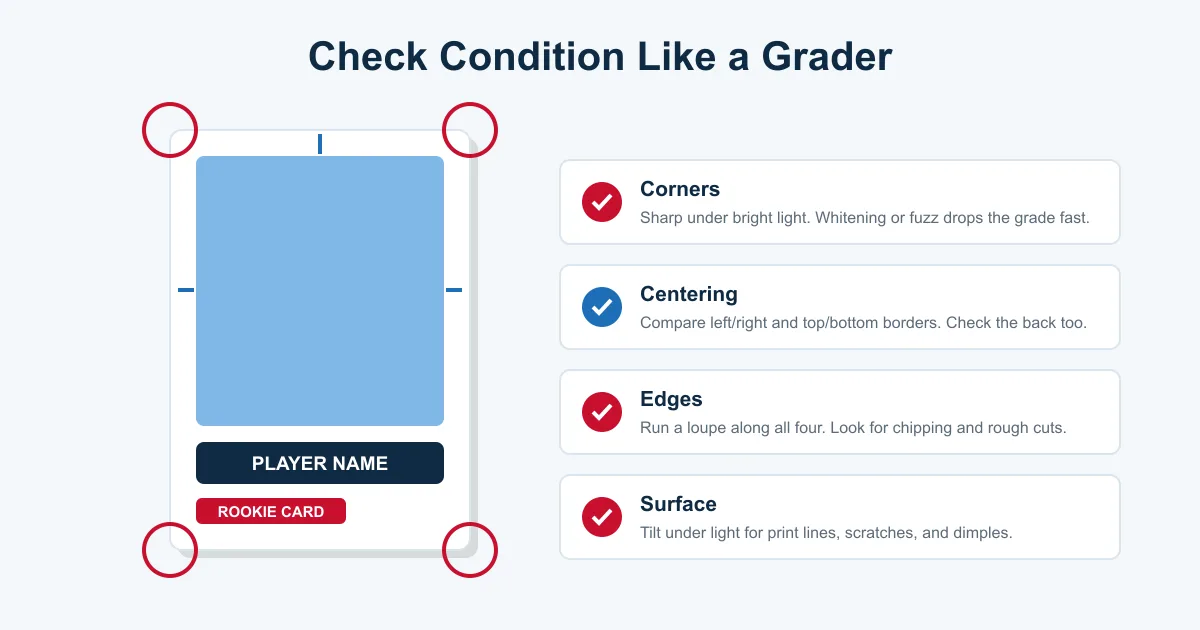
- Corners: look at all four under bright light. Any whitening, fuzz, or rounding is visible immediately to a grader and should be visible to you.
- Centering: compare the left and right borders, then top and bottom. A 60/40 split or better is generally fine for high grades; worse than that caps the grade no matter how clean the rest is. Flip it over, because back centering counts too.
- Edges: run a loupe (or your phone camera zoomed in) along each edge looking for chipping and rough factory cuts.
- Surface: tilt the card under a light and watch for print lines, scratches, dents, and dimples. This is where “pack fresh” cards fail most often, since plenty of damage happens before the pack is ever opened.
If you want the exact standards graders use, PSA publishes its grading standards and they’re worth ten minutes of reading before your first submission.
Is Grading Worth It? Run the Numbers
Grading costs roughly $20 to $25 per card at the standard tier (full cost breakdown here), plus shipping both ways and a few weeks of waiting. So a card is only worth grading when a strong grade sells for meaningfully more than the raw value plus the fee. The complete grading guide covers the whole world of PSA, BGS, and SGC; for the quick answer, run your card through this:
Grading ROI Calculator
Plug in values from eBay sold listings and see if grading beats selling raw.
Be brutally honest about condition before submitting, using the checklist in the condition section above. Overestimating your card’s grade is the fastest way to set fire to a grading fee. When in doubt, assume the 9, not the 10, and see if the math still works. For the deeper version with three grade outcomes, use the full ROI calculator, and if you’re wondering what a 10 even requires, gem mint is explained here.
Where to Sell Hockey Cards
Once you know what a card is worth, pick the venue that fits it:
| Venue | Expect to Get | Best For |
|---|---|---|
| eBay | Market price minus ~13% fees | Almost everything; biggest buyer pool sets the price |
| Local card shop | 50-70% of market | Speed and bulk; walk out with cash today |
| Consignment / auction house | Market minus commission | High-end cards where presentation and reach matter |
| Card shows | Negotiable, near market | Meeting buyers face to face, no shipping |
| Facebook groups / forums | Near market, no fees | Hobby regulars, but vet buyers carefully |
The rule of thumb: cheap bulk goes to the shop or stays in the closet, mid-range singles go to eBay, and anything special enough to make you nervous goes to consignment. Check each card’s sold prices first so you’re negotiating from the actual number, not a hope. The full selling guide covers each venue in detail, and the buying guide is its mirror image for the other side of the table.
What to Do Next
- Selling? Pull recent sold prices for your key cards first, then choose the venue from the table above that fits the card.
- Keeping? Sleeve and toploader anything worth more than a few dollars, and store cards away from humidity and sunlight.
- Staying in the loop? The news feed tracks fresh pulls, releases, and creator videos, and the blog has every guide on the site.
- Just curious? Enjoy the shoebox. The best part of finding old cards was never the money anyway.
This site is a hobby resource, not financial advice. Card prices move with the market, and nothing here is a guarantee of value.
Frequently Asked Questions
Are hockey cards worth anything?
Most hockey cards are worth under a dollar, but key rookie cards, serial-numbered cards, graded gems, and pre-1980 vintage can be worth serious money. The only way to know is checking recent eBay sold prices for your exact card.
What hockey cards are worth money?
Rookie cards of stars and legends, serial-numbered and short-print cards, high-grade vintage, and cards graded PSA 9 or 10. Player, scarcity, and condition drive almost all value.
What is a rookie card?
A rookie card is a player's first card in a major licensed set. In modern hockey, the most famous example is the Upper Deck Young Guns subset. A player's rookie card is almost always their most valuable base card.
Are 90s hockey cards worth anything?
Usually no. Cards from roughly 1988 to 1994 were printed in massive quantities, so even stars sell for pocket change. Exceptions include graded gem-mint copies of key rookies and the 1990-91 Upper Deck set in perfect condition.
How much does it cost to grade a hockey card?
Standard-tier grading runs about $20 to $25 per card at PSA. A card is only worth grading when a strong grade would sell for meaningfully more than the raw value plus the fee. Try the calculator in this guide to run your own numbers.
Where can I sell my hockey cards?
eBay reaches the most buyers and sets the market price. Local card shops pay faster but usually offer 50 to 70 percent of market value. For expensive cards, consignment services and auction houses are also worth a look.