What Is a PSA 10? Gem Mint Explained
Every hobby has its magic words, and ours are “PSA 10”. Gem Mint. The grade that turns a $50 card into a $400 card and a famous rookie into a record auction headline. This guide covers what the grade actually requires, why the market pays so violently for it, and how to judge, honestly, whether the card in your hand has a shot.
Key Takeaways
- PSA 10 means virtually perfect: sharp corners, clean edges, flawless surface, ~55/45 centering or better.
- The 9-to-10 price jump is non-linear because gem copies are scarce and collectors pay for "the best".
- Surface flaws kill more 10s than corners do. Tilt the card under strong light before dreaming.
- The PSA population report tells you exactly how rare a 10 is for your specific card.
Table of Contents
The Official Definition
PSA’s published grading standards define Gem Mint 10 as a virtually perfect card: four sharp corners, sharp focus, full original gloss, and centering of approximately 55/45 or better on the front (up to 75/25 on the back). “Virtually” is doing real work in that sentence: a 10 tolerates the faintest of flaws under close inspection, like a minor printing imperfection, as long as nothing detracts from the card’s overall appearance.
One grade down, PSA 9 Mint allows exactly one minor flaw: a touch of wax staining, slightly off-white borders, one fractionally soft corner. The distance between those two definitions is a hair’s width, and the distance between their prices is a canyon.
What a 10 Requires in Practice
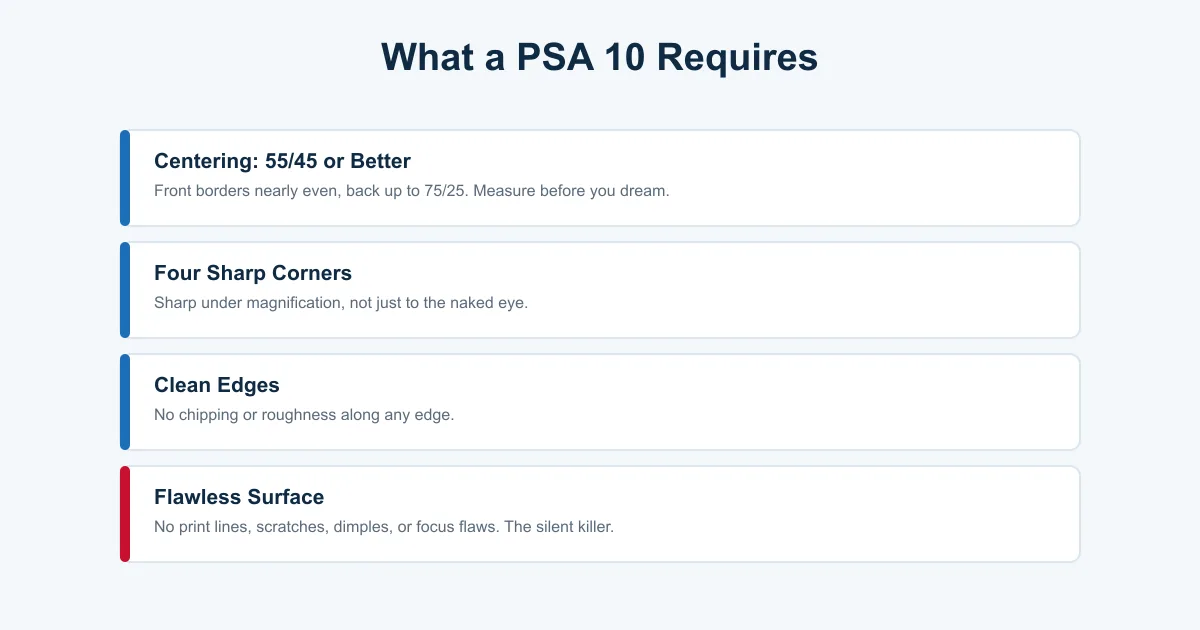
Translating the standards into what graders actually catch, in the order they catch it:
- Surface, the silent killer. Print lines, tiny scratches, dimples, focus flaws, factory gloss breaks. Most heartbreak 9s were surface calls invisible until the card tilts under strong light. Modern glossy stock shows everything; 80s O-Pee-Chee stock hides sins until magnification.
- Centering, the measurable one. Measure the borders instead of eyeballing: left/right and top/bottom, front and back. 60/40 looks centered to a happy owner and grades like 60/40 anyway.
- Corners under magnification. Sharp to the naked eye is the entry fee; sharp at 10x is the grade. A loupe costs less than one wasted grading fee.
- Edges. Chipping and rough cuts, the classic vintage and junk-era tell. Run the loupe along all four.
This is the same condition checklist from the values guide, applied at maximum severity, because that’s exactly what the grading room does.
Why the 9 to 10 Jump Is So Extreme
Two forces stack:
- Real scarcity. For condition-sensitive cards, only a small share of submissions gem. The 10 population might be a tenth of the 9 population, and price follows supply.
- Trophy psychology. Collectors don’t just buy condition; they buy “the best one”. Registry sets, bragging rights, and the simple human pull of a perfect thing mean demand concentrates at the top grade far beyond what the condition difference “should” be worth.
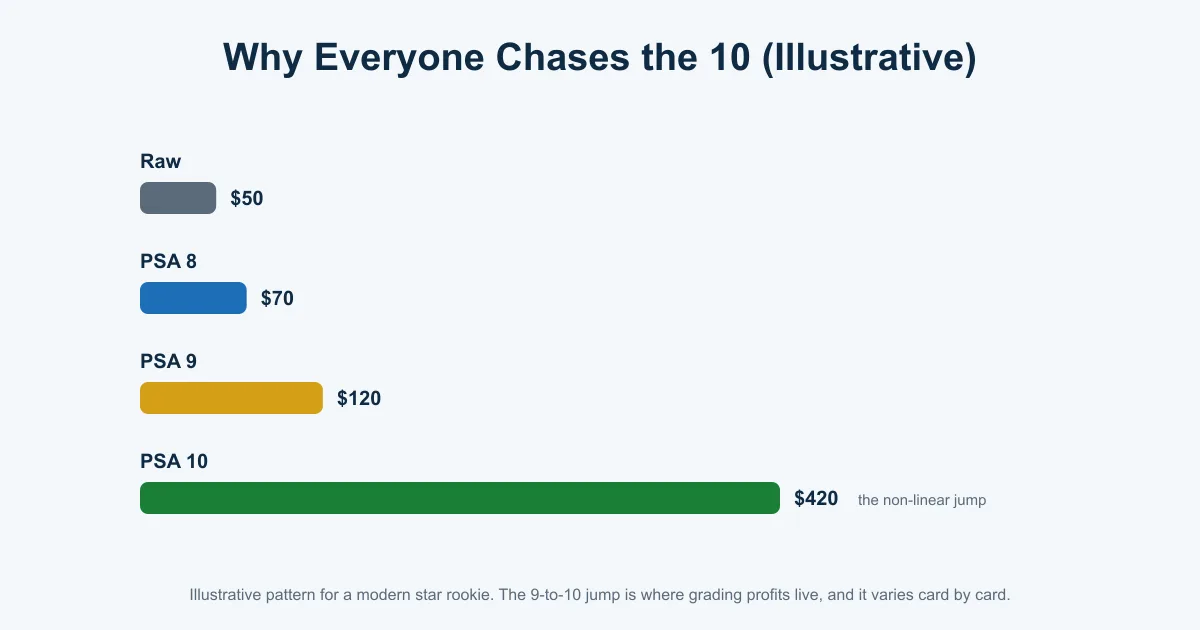
The result is the non-linear curve every seller dreams on: raw $50, PSA 9 $120, PSA 10 $420 (illustrative, and card-specific). It is especially dramatic on modern rookie cards, where a star’s Young Guns PSA 10 can sell for several times the raw copy. This curve is also the entire engine of the grading ROI math: the expected value of a submission is mostly “probability of a 10 times the size of that jump.”
Checking the Population Report
Before paying a gem premium or submitting a card chasing one, spend two minutes in the PSA population report. It lists, for every card PSA has ever graded, how many copies exist at each grade. Reading it tells you:
- How hard the 10 really is. A card with 4,000 nines and 300 tens is a tough gem; one with tens outnumbering nines gems easily, and its 10 premium is thinner.
- Whether the premium is durable. Low-pop 10s of iconic cards hold their premium; high-pop modern 10s watch it erode as more supply gets graded and gems.
- What you’re actually buying. “Pop 12” on a listing means twelve PSA 10s exist. Now the price asks a better question: what are the other eleven selling for? Sold listings on eBay answer that, and the lookup method takes two minutes.
Does Your Card Have a Shot?
Gem Shot Estimator
Answer honestly and get a realistic read on your card's PSA 10 chances.
The honest headline from my own submission history: cards I was sure would gem ran about half. The grading room sees with better light, better magnification, and none of your affection.
The Gem Mint Economy
Understand the 10 and you understand most of modern collecting: why grading exists, why fresh-pulled cards go straight into sleeves, why “pack to slab” is a genre, and why a $25 grading fee is either the best or worst money in the hobby depending entirely on one number under a loupe. Respect the grade, measure before you dream, and let the population report keep you honest. The 10 is a wonderful thing to hit precisely because it refuses to be promised.
Grading standards belong to PSA and outcomes vary card by card. Value patterns are illustrative. Not financial advice.
Frequently Asked Questions
What does PSA 10 mean?
PSA 10, Gem Mint, is the top grade on PSA's scale: a virtually perfect card with sharp corners, clean edges, flawless surface, and centering of roughly 55/45 or better on the front.
Why are PSA 10 cards worth so much more than PSA 9?
Scarcity and psychology. For many cards only a small fraction of graded copies earn the 10, and collectors pay heavily for owning the best possible version. The result is a non-linear price jump from 9 to 10.
Does PSA 10 mean the card is perfect?
Virtually perfect, not literally. A PSA 10 allows the faintest flaws under close inspection, like a minor print imperfection. The stricter public perception of perfection is part of what the market pays for.
How rare is a PSA 10?
It varies wildly by card. The PSA population report shows exactly how many copies of any card exist at each grade, which is the first thing to check before paying a gem premium or submitting a card chasing one.