Hologram Hockey Cards: Are 90s Inserts Worth Anything?
Every 90s hockey collection has them: the hologram cards, glinting up from the binder like they must be worth something. Shiny meant special, right? Sometimes. This guide sorts the hologram and insert cards that actually carry value from the ones that are just fun to tilt in the light, and I say that with a full page of them in my own collection that I love and would struggle to sell for lunch money.
Key Takeaways
- Upper Deck base team holograms were in nearly every pack for years: shiny, nostalgic, nearly worthless.
- Value concentrates in scarce chase inserts (steep pack odds), stars, and gem-graded copies.
- Hologram surfaces scratch easily, so clean copies are scarcer than print runs suggest.
- Check pack odds on old wrappers: 1:72 inserts are a different world from 1-per-pack holograms.
Table of Contents
Why Holograms Took Over the 90s
Upper Deck launched in 1990-91 with holograms as its anti-counterfeiting badge and premium flourish, and the tech became the era’s signature. Team logo holograms rode along in essentially every pack, McDonald’s ran all-hologram promo sets in Canada, and by mid-decade every manufacturer was chasing shine with foil, prisms, and refractor-style finishes.
Here’s the catch you already know if you read the junk wax guide: being in every pack is exactly the problem. A hologram printed millions of times is a common card with better lighting. The shine says nothing about scarcity, and scarcity is what pays.
The insert boom that followed is the real story. When the base-card market collapsed, manufacturers created cards with stated pack odds (1:24, 1:72, and steeper), and those odds created the first genuine scarcity since the 70s. That’s the line that divides this whole category: seeded everywhere versus seeded scarce.
Which Holograms and Inserts Hold Value
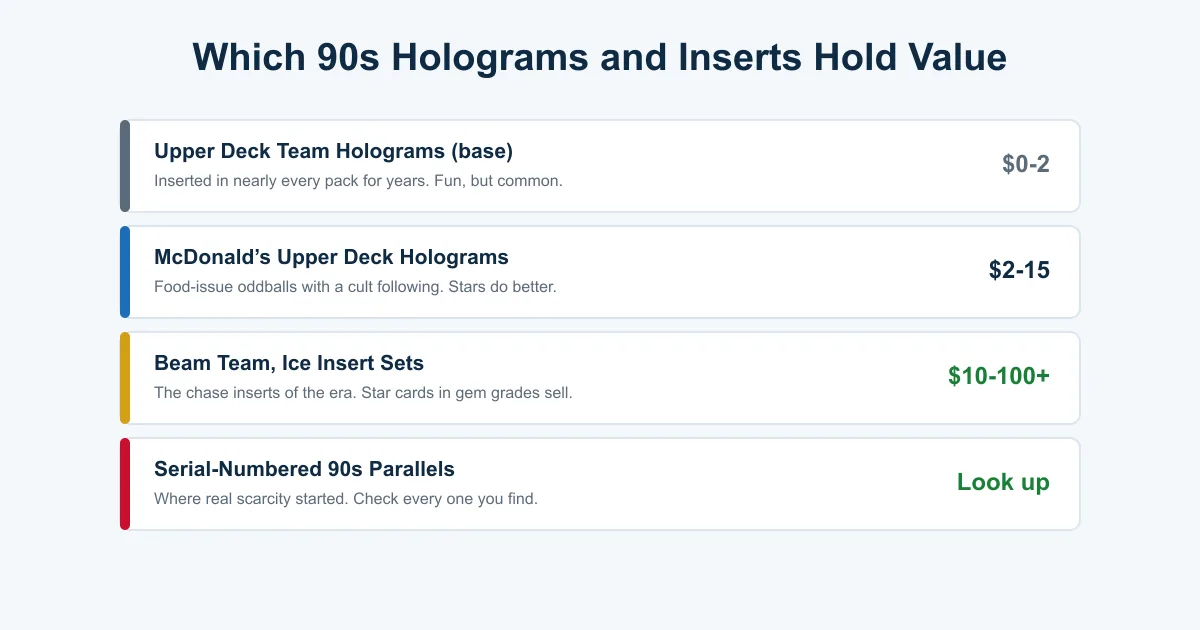
- Base team holograms: $0-2. Nostalgia cards. Complete runs in perfect shape sell as lots for a little, and that’s the ceiling.
- McDonald’s Upper Deck holograms: $2-15 for stars. A genuine cult classic in Canada. Gretzky and Lemieux in flawless condition outperform the tier, and complete sets find buyers. Check SportsCardsPro for current set and single prices.
- Chase inserts (Beam Team tier): $10-100+. The era’s marquee inserts with tough odds. Star cards, especially graded gems, are the junk-wax era’s best survivors and belong on any what’s-worth-money shortlist.
- Serial-numbered parallels: look up every one. When print runs are stamped on the card, scarcity stops being a guess. Any 90s card numbered under 1,000 deserves a sold-listing check before it goes anywhere.
The Three Checks for Any Insert
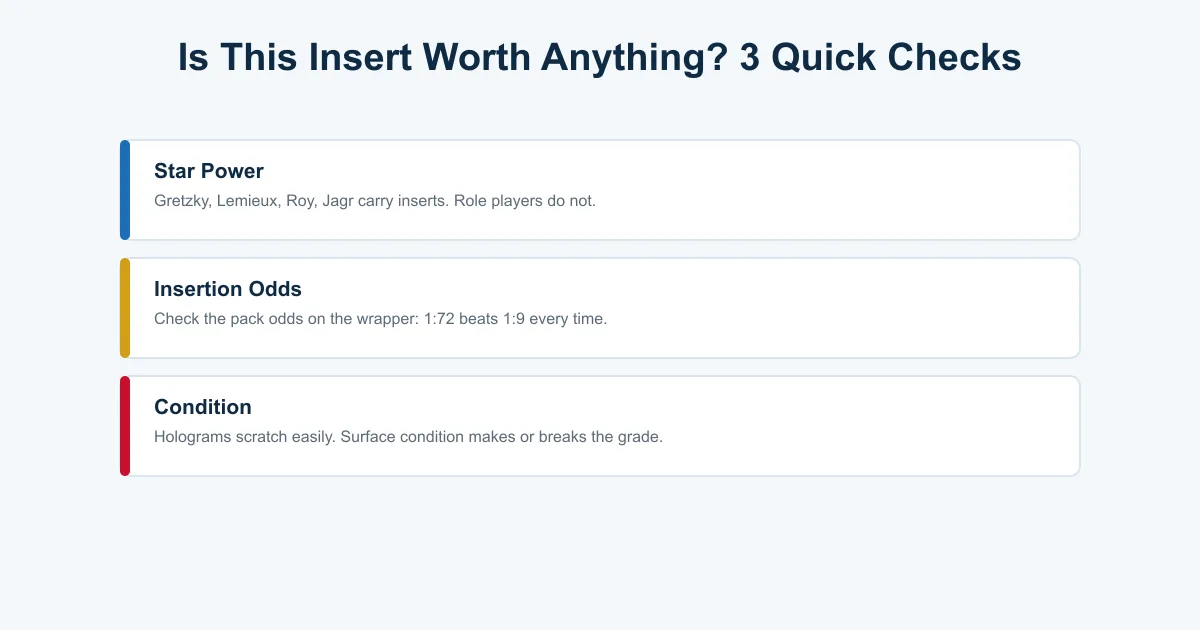
- Star power. Inserts amplify the player; they don’t replace him. A scarce insert of a fourth-liner is scarce and worthless. The same insert of Gretzky, Lemieux, Roy, or Jagr is the one the market wants.
- Insertion odds. The wrapper is the document: 1:72 is a chase card, 1:9 is decoration. No wrapper? The Trading Card Database lists insert sets and odds for the era.
- Surface condition. Holograms and foil scratch if you breathe on them, and most lived loose in boxes for decades. Tilt the card under strong light; the scratches announce themselves. Clean copies carry the value, which is the same condition story as everywhere in this hobby, just harsher.
Insert Value Checker
Is This Shiny Card Worth Anything?
A quick verdict for any 90s hologram or insert.
The Insert Sets Worth Knowing
A few names come up over and over when 90s hockey inserts change hands, and they’re the ones worth learning to spot on sight:
- 1993-94 Topps/OPC Premium Black Gold: the era’s breakout chase design, and star cards still trade actively.
- 1994-95 Upper Deck SP inserts and early SP rookies: the premium line that pointed toward the modern hobby.
- 1995-96 Upper Deck Ice acetate cards: clear plastic stock that survived badly, making clean copies genuinely tough.
- Early McDonald’s Upper Deck hologram sets: the food-issue classic, strongest for Gretzky and Lemieux.
- Anything stamped with a serial number: the bridge to the modern era, and always worth a lookup.
Set checklists and insertion odds for all of these live on the Trading Card Database, and current market prices are a values-guide lookup away. If a binder page in your collection matches one of these names, that page earned a real check.
Grading Hologram Cards
Grading makes sense for exactly one slice of this category: clean chase inserts and low-numbered parallels of stars. For those, the gem premium is real because scratch-free copies are legitimately hard to find, and the PSA population report for 90s inserts shows surprisingly thin gem counts on cards everyone owned.
For everything else, the math fails before it starts: the fee outruns the ceiling. Run any candidate through the full grading ROI calculator before submitting, and be merciless about surface scratches, because the grader will be. New to grading entirely? Start with the complete grading guide.
If your tilt-check turns up a winner, congratulations: you beat the junk wax odds. Now go get its real number from the solds and decide whether it’s a keeper or heads to market.
Value ranges are planning estimates from recent marketplace sales as of July 2026. Verify your exact card against current sold listings.
Frequently Asked Questions
Are hologram hockey cards worth anything?
Most are not. Upper Deck base team holograms were inserted in nearly every pack for years. Value lives in the scarce chase inserts of the mid 90s, star cards in gem grades, and early serial-numbered parallels.
Are McDonald's hockey cards worth money?
Usually a few dollars at most, but McDonald's Upper Deck holograms have a real cult following, and star cards in perfect condition sell better than typical junk wax. Complete sets in nice shape find buyers too.
What are insert cards?
Inserts are special cards seeded into packs at stated odds alongside the base set, like one per 72 packs. The mid 90s insert boom created the scarcity that junk wax base cards lacked, which is why good inserts kept value.
Why are my hologram cards scratched?
Hologram surfaces scratch far more easily than regular cardboard, and most were stored loose in shoeboxes. Surface condition is the main grade killer for holograms, which makes clean copies scarcer than you would think.